
How Much Does Infrared Heating Cost to Run? A Simple Winter Calculator
Every fall, the same question shows up before the first cold snap: what is heating going to do to my power bill? This year the worry is fair. A ConsumerAffairs report on 2026–27 winter projections puts the average household heating cost at about $1,030, which is $82 more than last winter, with electric heating expected to rise around 9%.
If you are weighing infrared heaters for a room, a garage, or a patio, you don’t have to guess at what they’ll cost. Infrared heaters run on electricity, so their operating cost comes down to one short calculation. This guide walks through it, shows what pushes the number up or down, and offers practical ways to keep it low.
The Running-Cost Formula
You need three numbers, and you can find all of them in about five minutes.
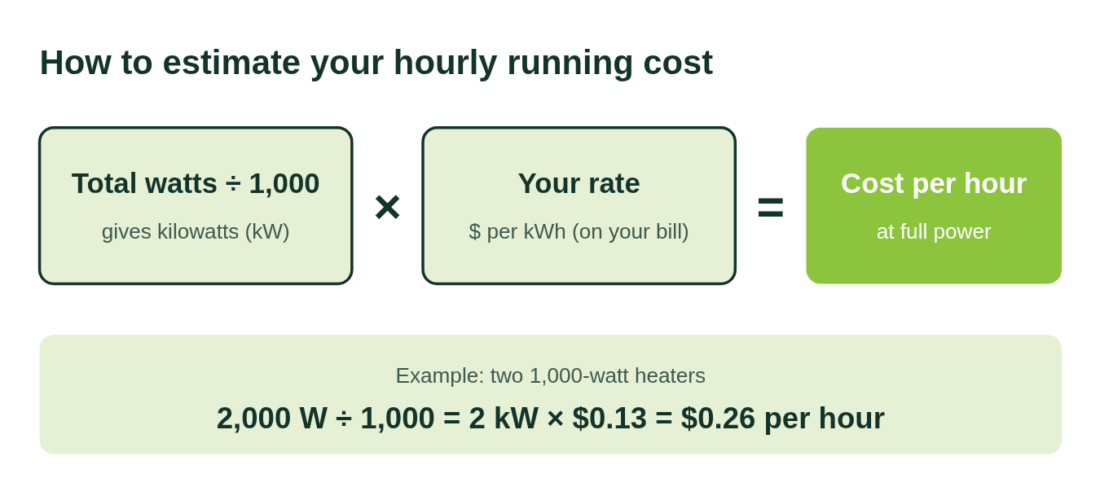
- Add up your total watts. Two 1,000-watt heaters equal 2,000 watts, or 2 kilowatts (kW). Divide watts by 1,000 to get kilowatts.
- Find your electricity rate. Your utility bill lists your cost per kilowatt-hour (kWh). If you can’t find it, your utility’s website or customer service line can tell you. Rates vary a lot by state and by provider.
- Multiply kilowatts by your rate. The result is your cost for each hour the heaters run at full power.
Here is an example. Two 1,000-watt heaters make 2 kW. At $0.13 per kWh, that’s 2 × $0.13 = $0.26 per hour. To get a daily or monthly figure, multiply by the hours you expect to run the heaters.
What That Looks Like Over a Month
Hourly numbers are hard to picture, so here is the same math at a larger scale. The chart below shows the estimated monthly cost of running a single heater for four hours a day over 30 days, at $0.13 per kWh.
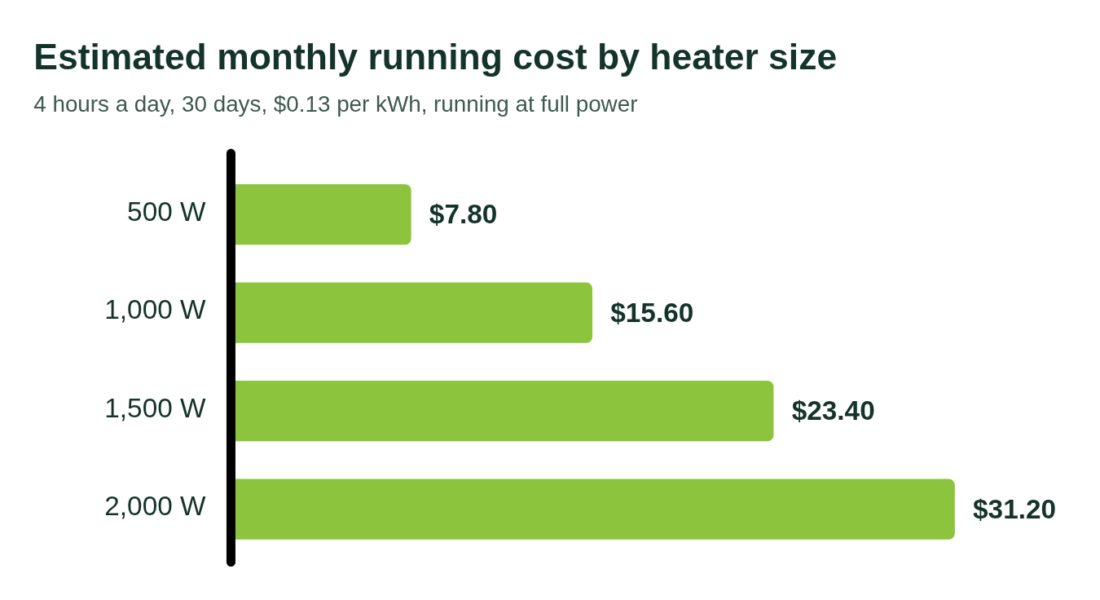
These figures assume the heater runs at full power during that span of 4 hours. In practice, a thermostat cycles the heater on and off once the space is comfortable, so real-world use is often lower. Treat the chart as a ceiling for that scenario, then swap in your own rate and hours.
A Quick Rule of Thumb
A 1,000-watt heater running for one hour uses exactly one kilowatt-hour, so its hourly cost equals your electricity rate. If you pay $0.20 per kWh, a 1,000-watt heater costs about $0.20 per hour at full power, and a 1,500-watt heater costs about $0.30. Once you know your rate, you can size up almost any heater in your head, which makes it easy to compare options before you commit to a purchase.
Why Your Heating Bill Is Different from Anyone Else’s
Two homes with identical heaters can see very different costs. The main reasons:
- Where you live and your electricity rate. Neighbors on the same utility usually pay similar rates, but rates can differ a lot between states and utility areas. A friend across the country may pay half as much, or twice as much, for the same kilowatt-hour.
- Your building envelope. Insulation, window quality, and drafts determine how fast heat escapes. A leaky room needs more run time to stay comfortable.
- Your climate and the weather. A mild week and a deep freeze produce very different run times.
- Your space. Ceiling height, room size, and layout all affect how much heating you need.
- Your thermostat settings and habits. Indoor infrared heaters are typically controlled by a thermostat, which cuts power once the room reaches its set point. The lower you set it, and the more you use scheduling to turn it down while you’re asleep or away, the less energy your heaters use.
The same logic applies outdoors. A covered, wind-sheltered patio holds warmth far better than an open deck, so the same heater can feel very different from one space to another.
Ways to Keep Infrared Heating Costs Down
- Heat the space you are actually using. Infrared is a form of spot heating: it warms people and objects directly. Those objects then re-radiate the warmth, which also gently warms the air around them. That makes infrared well suited to the areas where you spend your time, such as a home office, a living area, or a workshop, instead of conditioning every room equally.
- Use your thermostat’s set point and schedule. Indoors, the thermostat decides when power reaches your heaters. When the room hits your set point, the heaters cycle off, and they cycle back on when the temperature drops. Most indoor thermostats don’t have timers that run heat for a fixed number of hours, but many offer scheduling, which lets you set lower temperatures for the hours you’re asleep or away. Outdoors, timers are the better tool, as the last tip explains. Our indoor controls and outdoor controls are designed to pair with our heaters for exactly this reason.
- Size the system correctly. An undersized setup runs constantly and never quite catches up. An oversized one costs more up front than it needs to. Our heating calculator helps you estimate how many heaters your space needs before you buy.
- Match your heating to how you use the space. Indoors, avoid turning heat off entirely when you leave a room or the house. Turn the temperature down to a baseline instead. Many thermostats can be set as low as 45°F, which keeps the space conditioned and helps prevent pipes from freezing while you’re away. When you’re home, it’s common to lower rooms you aren’t using to 55–60°F. Outdoors, a timer is the ideal tool: set it so your heaters run at 100% output for a fixed interval while you’re using the space, rather than leaving them on all evening.
Indoor and Outdoor Costs Are Different Things
Indoor heating is usually a long-running cost, with heaters cycling through the day during cold months. Outdoor heating tends to be a short-burst cost. Consider a patio setup drawing 3 kW for a three-hour evening gathering. That’s 9 kWh, or about $1.17 at $0.13 per kWh. Run it twice a week and the monthly total stays modest.
Heated furniture can bring that cost down even further. It uses less energy than a patio heater, and because it warms the person sitting in it rather than the air around the furniture, less energy goes to waste. For seating areas where guests tend to stay put, it’s an attractive way to keep operating costs low, either on its own or alongside a patio heater.
That is why outdoor heating often makes sense even for people who would never heat a space continuously. You pay only for the hours you are out there.
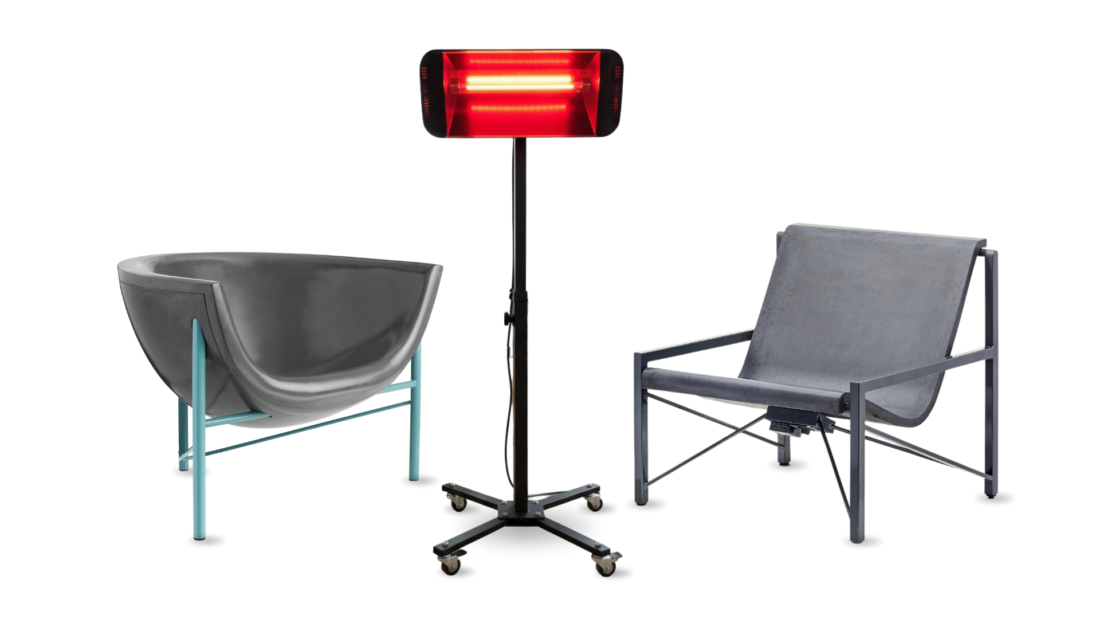
In photo: Heliosa 66 Black Heater with Rolling Stand and Heated Furniture by Galanter & Jones
Is Infrared the Cheapest Way to Heat? An Honest Answer
Any electric resistance heater, infrared or not, turns each kilowatt-hour of electricity into roughly one kilowatt-hour of heat. If the only goal were to warm a given volume of air, infrared wouldn’t beat a baseboard. The savings come from heating for comfort rather than just heating air, and from what happens over the life of the system.
Zone control matters, but it isn’t the main reason. Baseboards and other heaters can be zoned too. Three things set infrared apart.
- Lifecycle cost. Heating systems vary widely in how long they last and what they cost to maintain. Many need ongoing maintenance or have shorter lifespans, so repairs and replacements add to what you spend over time. Our SolaRay-II panels are engineered to last approximately 350,000 hours with no maintenance required, and they carry a lifetime warranty. For perspective, 350,000 hours is about 40 years of nonstop operation. Over the long run, avoiding repair and replacement costs can matter as much as the monthly electric bill.
- Objects hold heat better than air. Infrared heats objects first: floors, furniture, walls. Those objects absorb the heat and hold it longer than air does. A convective system simply blows hot air through a room, and that warmth is gone as soon as the air escapes or the system shuts off. You can see the same principle in a fireplace hearth. The large stone surface soaks up heat from the fire, then keeps releasing warmth into the room long after the fire is out. Passive homes use it too. South-facing windows set low let the winter sun, nature’s own infrared, shine onto an insulated concrete slab, which stores the heat and releases it slowly through the day and night. In summer, the sun’s higher angle keeps it from shining in directly. This is why thermal mass pairs so well with infrared heat: more objects absorbing and holding warmth means less heat loss and steadier comfort.
- A lower thermostat setting for the same comfort. Infrared adds warmth you feel on top of the air temperature, often 5 to 10 degrees for an indoor infrared heater. That lets you set your thermostat lower and feel just as comfortable as you would with a convective system. This matters because heat loss depends on the difference between inside and outside temperatures. If it were the same inside and out, no heat would escape at all. Lower the indoor air temperature in the cold months, and you shrink that difference and the heat leaking to the outdoors, regardless of your building envelope.
Taken together, these three factors explain why infrared can cost less to live with, even though every electric heater turns a kilowatt-hour into the same amount of heat. A system that lasts for decades, stores warmth in the objects around you, and lets you keep the thermostat lower delivers comfort for less over time. That long-term view, more than any single month’s bill, is the real cost advantage.
Estimate Your Own Cost Before You Buy
The best way to avoid a surprise is to run the numbers for your own space:
- Use our heating calculator to estimate how many heaters you need.
- Multiply the total wattage by your local rate using the formula above.
- Decide how many hours a day you realistically expect to run the system.
If you’d like help, tell us about your project. We’ll quote and deliver the right heaters and controls for your space.

About the Author
Jeff Abel
Jeff Abel serves as Vice President of Sales at Heating Green and has supported thousands of yoga and fitness studio installations worldwide. He specializes in helping studio owners evaluate, design, and implement infrared heating solutions tailored to their unique spaces and business needs.